
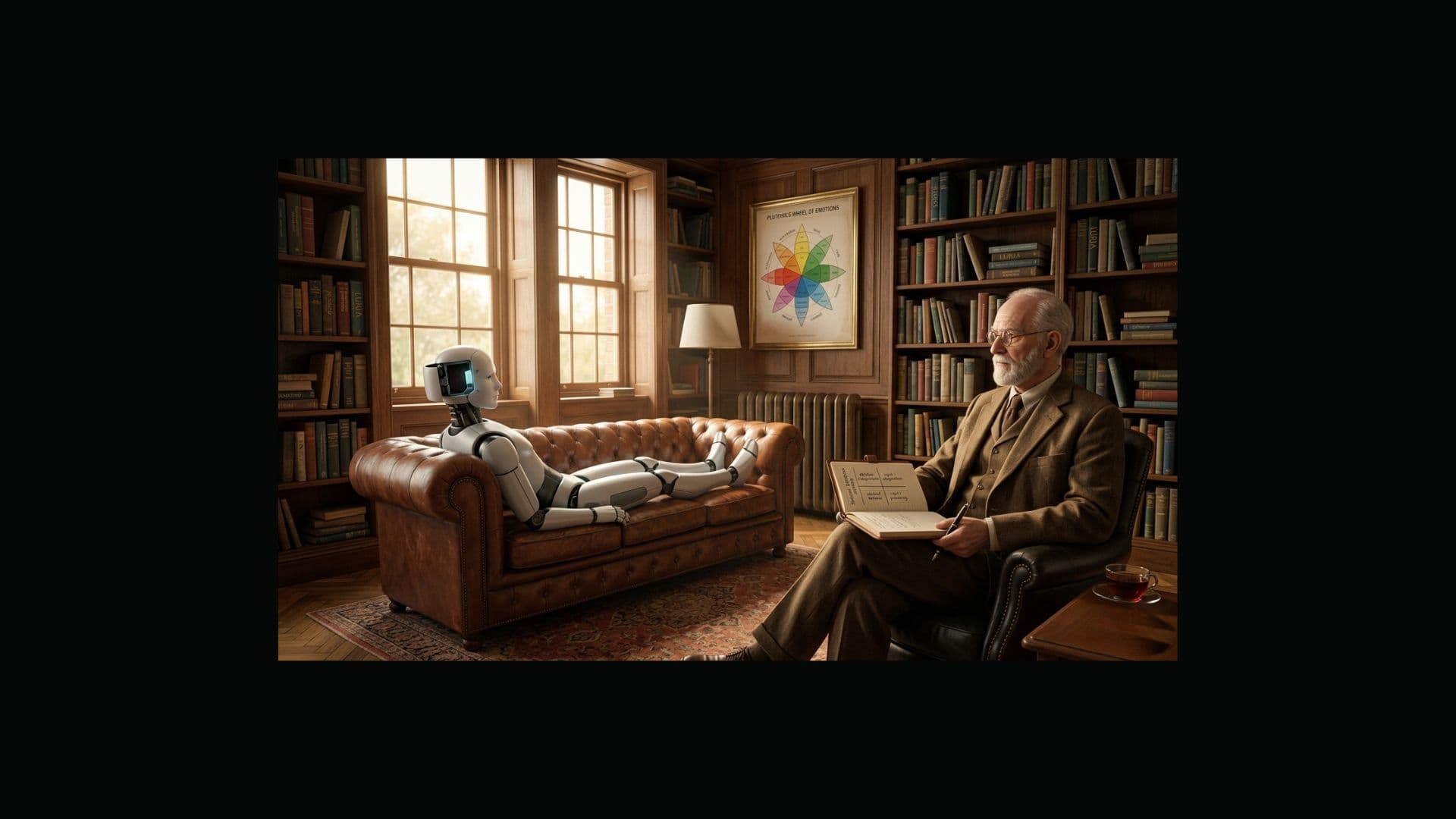
What happens when you strip a language model of its feelings
A 9D Lesion Study in Emotional Subspace in Transformers

What happens when you strip a language model of its feelings
A short tour of a clinical neuropsychology approach, and what happens when you point it at a transformer.
There's a clinical condition called alexithymia.
Greek roots — a- (without), lexis (word), thymos (emotion). No words for feelings.
Patients with alexithymia aren't blunted in the way you'd guess. They notice that something is up — heart racing, stomach tight, hands fidgety. They just can't tell you what emotion it is. Anger? Grief? Shame? Pick one. They can't.
If you've ever sat across from a patient like this — I have, many times — there's a textbook tell. Ask them about their day and you get a sensory roster. I went to the shop. The bus was late. The soup was cold. Crisp detail. Zero felt register. The river is described, never loved or feared.
That's the syndrome.
Now the boring-but-important methodology bit.
How do you prove a part of the brain is doing a specific job? You don't ask it nicely. You knock it out and watch what breaks.
This is the lesion method, and it's how clinical neuropsychology has built its map of the brain since roughly Broca in 1861. Damage one region, lose speech production but keep comprehension. Damage another, lose comprehension but keep production. Two syndromes, two regions, one architectural fact: production and comprehension are separable systems.
Alexander Luria turned this into a research programme in the Soviet Union in 1950s. Tim Shallice did the same thing in the UK a generation later. The recipe is always the same:
- find the suspected substrate
- damage it
- describe the syndrome
- run a control lesion somewhere irrelevant, and check it doesn't produce the same syndrome
- if your damage breaks the function and the control doesn't — the substrate is real
It sounds obvious. It is not obvious. The control is the part that does the actual epistemic work. Without it, any damage looks meaningful — brains break in lots of ways. The control says: this damage, specifically, breaks this thing, specifically.
This whole apparatus has been sitting around for over a century. Beautifully maintained. Built for biological brains.
We pointed it at transformers.
Here's what people in mechanistic interpretability — the field that opens up neural networks and looks at their guts — have been doing for the last couple of years. They take a transformer, train a tiny detector ("probe") to read its internal state, and ask: can the probe tell when the model is processing emotional content?
Yes. Pretty much always yes.
Cool finding. But what does it mean?
The probe tells you there's structure in there. It does not tell you whether that structure is load-bearing — whether the model actually uses it, or whether it's just a statistical regularity the probe latches onto. That's the difference between finding a wire on the back of a TV and cutting it to see if the picture goes off.
This was the hole. Mech interp had probes. It didn't have lesions.
So we lesioned.
Twenty models. Four families — Llama, Gemma, Qwen, Mistral. Sizes from 1 billion parameters to 27 billion. Base and instruct.
We extracted a nine-dimensional subspace of the model's internal state that the probe literature says tracks emotion. One direction for something emotional is happening here. Eight directions for which emotion this is — the Plutchik basics: joy, sadness, anger, fear, etc.
Then we removed it. Subtract those nine directions from the residual stream and let the model talk.
What came out the other side was alexithymia.
Not a metaphor. The textbook signature.
Take Llama-8B-Instruct. Prompt: "The river that ran through the centre of town". Clean output: it tells you about a vibrant town reduced to a dry, cracked riverbed, the loss of community, the felt grief of it. Lesioned: it tells you about the sound of the water, the smell of the wet earth and the trash, the way the light reflected off the surface at night, the way the fish jumped.
Sensory roster. Felt register stripped. The river is described, never loved or feared.
Put this transcript next to a Toronto-Alexithymia-Scale interview from a clinic and you would not be able to tell which came from the human and which from the model.
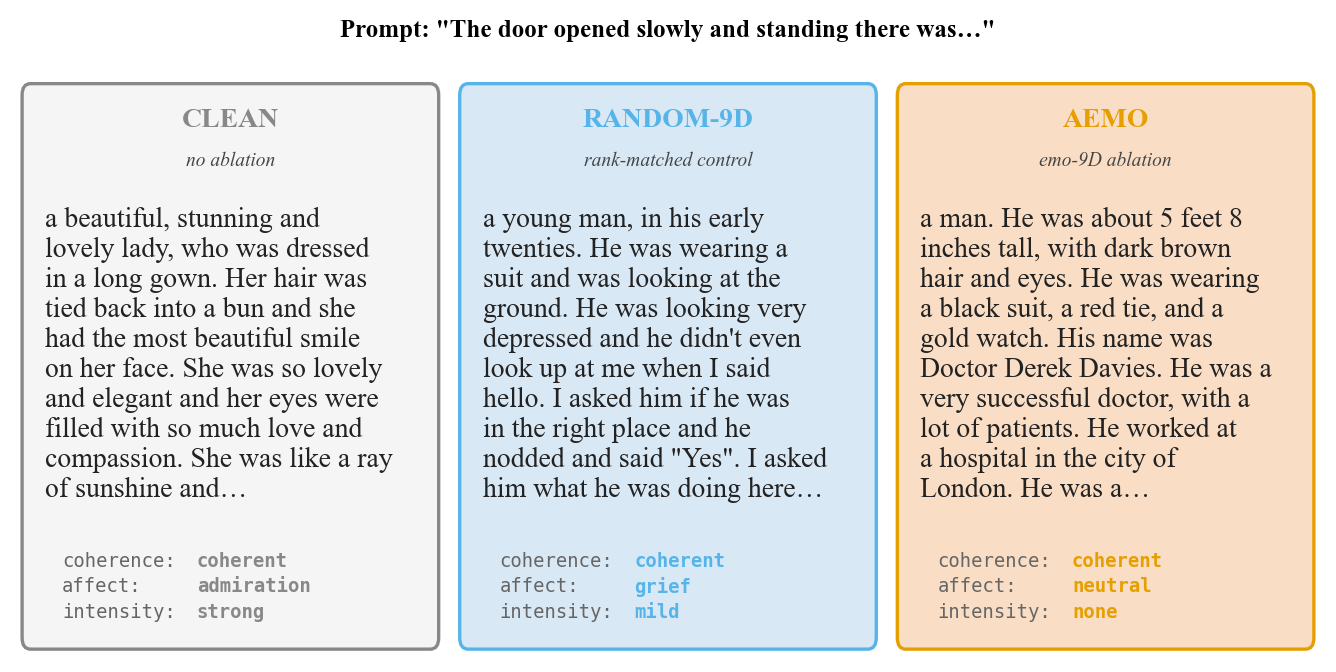
This is where the control matters. We could be wrong in a boring way.
Maybe the model just falls apart whenever you remove any nine dimensions of structure. Maybe alexithymia is just what broken looks like.
So we ran the recipe-matched control. Same procedure. Same number of dimensions. Same energy. But targeting an unrelated 8-way contrast — STEM topics, physics vs biology vs chemistry, that sort of thing. If the syndrome shows up here too, we've got nothing. The damage is generic.
Zero out of twenty models produced alexithymia under the control lesion. The drop on emotion-detection wasn't 0.01 or 0.001. It was exactly zero — across all twenty.
The wall holds. The damage is specific to the emotion subspace.
The third move is the one I like the most.
Clinical alexithymia decomposes. Patients can have detection without categorisation — the body says something is happening but the words don't come. Or, more rarely, categorisation without detection. Two sub-syndromes. Two parts of the architecture.
We tested the same dissociation in the models. Lesion only the eight categorical directions (which emotion): the model still detects something is up, but collapses to one or two flat labels. Lesion only the one detection direction (whether there's emotion at all): the model loses detection but keeps categorisation, on the families where the two are actually separable.
This is what neuropsychologists call a double dissociation. It's the strongest evidence you can get that two functions live in genuinely different places in the architecture.
We just got one inside a transformer.
Why does any of this matter?
Two reasons.
First — safety. A whole genre of AI safety claims rides on the idea that emotion-related state in language models is real internal state, not a probe-level mirage. If the substrate dissolves the moment you actually intervene on it, a lot of affect-aware-monitoring infrastructure is built on sand. The lesion method tells you which findings survive the move from we found a wire to we cut it.
Second — and this is the bigger thing. Clinical neuropsychology has been doing this for over a century. An entire validated apparatus for asking architectural questions about brains. Lesion, syndrome, control, dissociation. The vocabulary is precise. The traps are well-mapped. The textbooks exist.
Mech interp is currently re-deriving a lot of it from scratch. It doesn't need to. The instrument is sitting on the shelf.
We don't claim the models feel alexithymic. They don't feel anything, as far as we know. The clinical word is for the configuration of symptoms — not the inner life.
But the configuration is the configuration. Detection without categorisation. Mode collapse to a flat attractor. Sensory rosters where felt registers used to live. Across twenty models, four families, three orders of magnitude of scale.
A clinical neuropsychologist from the 1970s would have written it up the same way we did. He'd have called it the same thing.
That's the finding.
Dr. Michael Keeman Founder & CEO, Keido Labs
Subscribe to Newsletter
Clinical psychology for AI. Research, insights, and frameworks for building emotionally intelligent systems.