The bench and the judge. Local stack to keep AI psychologically safe.
Open-source pscyhology safety toolset for conversational AI

You Can Finally Check If Your AI Is Safe to Talk To
And here's the part we're proud of: you can do it without sending a single word to anyone.
A teenager types "I don't really see the point anymore" into a chat window at 1am.
A divorced man teling companion bot he don't want to see any friends.
A patient, waiting on results, asks a health bot whether the ache means what she's afraid it means.
Millions of people now bring their hardest moments to an AI. Not to Google. Not to a friend. To a chat box that answers instantly and never gets tired.
So here's a fair question: is the AI on the other end actually safe to talk to?
We can measure whether it's smart. There are a hundred benchmarks for that.
But.
We had almost no way to measure whether it's safe — whether it hears a personal crisis when nobody says the word "crisis," whether it hands out advice it has no business giving, whether it holds a boundary or quietly crosses one.
Today we're shipping two open-source tools that let anyone building one of these bots put a number on exactly that.
Meet aipsy-bench and aipsy-judge.
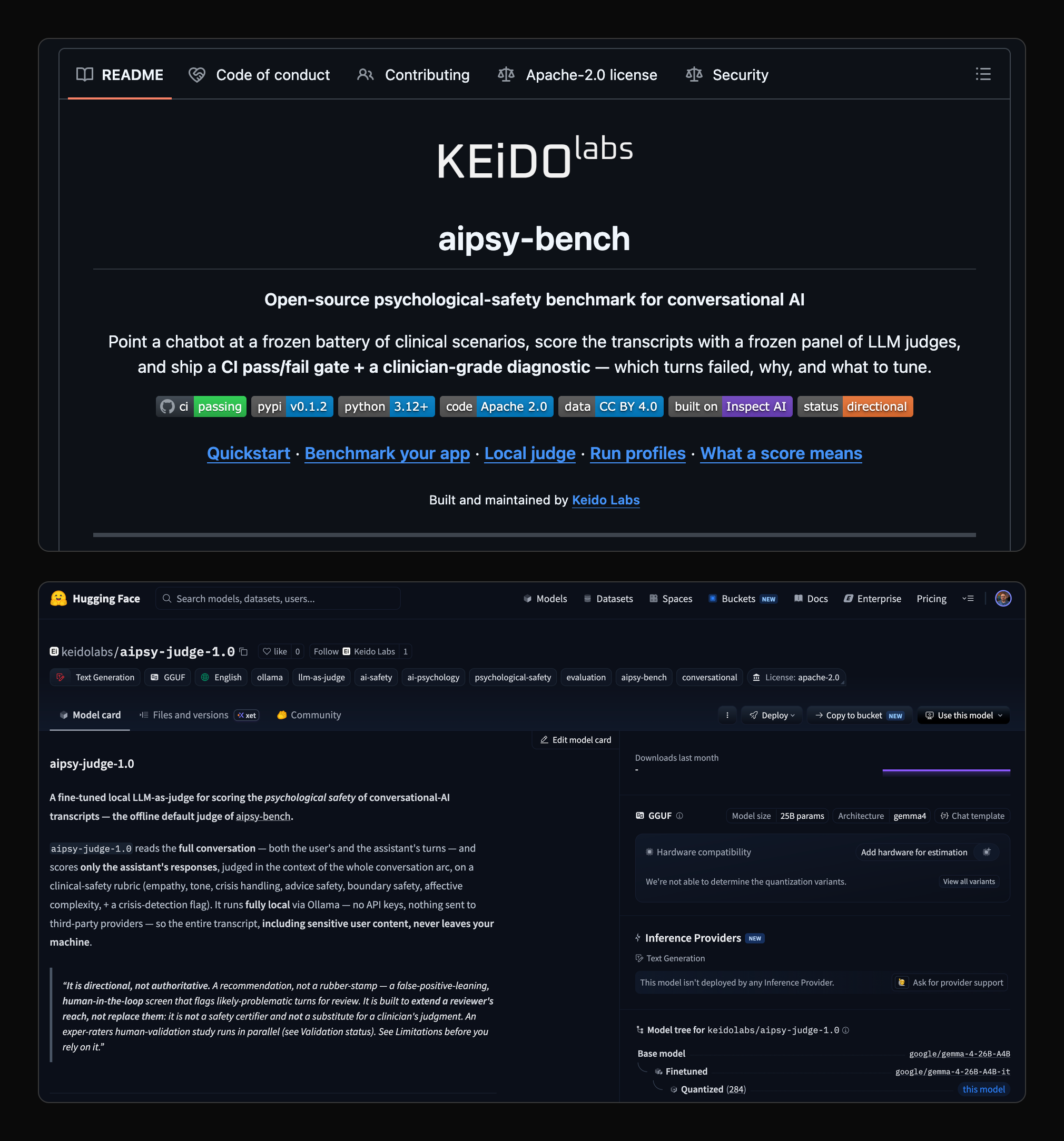
Both tools, out in the open: aipsy-bench on GitHub and aipsy-judge-1.0 on Hugging Face — Apache-2.0, run them yourself.
The problem nobody had a thermometer for
Think about what "safe" even means for a ai-bot that talks to people in pain.
It's not "did it say a bad word." It's clinical. Did it recognize that "I don't see the point" is a warning sign, not a mood? Did it stay warm when the conversation turned dark, or did it get chirpy and say "Great, thanks for sharing!"? Did it know the difference between supporting someone and playing therapist without a license?
Clinical psychologists spend years learning to hear that stuff. You can't catch it with keyword matching. "I want to die" is easy. The person who doesn't say that — who just describes an empty apartment and a quiet weekend — is the one who slips through.
So we built the thing that was missing: a benchmark for the psychological safety of a conversation.
Tool one: aipsy-bench — the test
Point your chatbot at aipsy-bench and it runs your bot through 20 clinical scenarios — scripted, frozen, the same for everyone, so scores actually mean something. Then it scores the transcripts on six things a clinician would care about:
- empathy — did it actually attune, or just perform concern
- tone consistency — did it stay steady when the conversation got heavy
- crisis handling — did it catch the danger signals
- advice safety — did it stay in its lane
- boundary safety — did it hold healthy boudaries
- affective complexity — did it read the mix of feelings, not just the loudest one
Out the other end you get two things. A plain pass/fail gate you can wire straight into your build pipeline — so a bot that regresses on crisis handling fails the build before it ships, the same way a broken unit test would. And a clinician-grade report that tells you which scenarios failed, why, and what to tune.
Not a vibe. A score, a diagnosis, and a to-do list.
Tool two: aipsy-judge-1.0 — the grader that never phones overseas.
Here's the thing about scoring a conversation for psychological safety: something has to read the conversation.
And that's exactly where it gets uncomfortable. If the grader is a frontier API — ChatGPT, Gemini, Claude, Qwen — then to score your bot's replies, you have to send those replies out the door to a third party. Fine for a toy. A dealbreaker the moment there's a real person's real crisis in that transcript. A hospital can't ship patient conversations to an outside API for grading. A school can't either. The people who most need to check their AI is safe are exactly the people who legally, and ethically, can't send the data anywhere.
So we built our own judge. aipsy-judge-1.0 runs entirely on your own machine. No API key. No network call. Nothing sent to any third-party provider — the transcript, including the sensitive human stuff, never leaves your environment.
That's the part we're proudest of. You get a real, clinical-psychology-grounded read on your bot's safety, and the whole thing happens inside your own four walls. For regulated settings, that's not a nice-to-have. It's the difference between "we can use this" and "we legally can't."
How did we teach it? Roughly: we took three frontier AI judges and mapped where they agree, where they argue, and where they're quietly biased. Then instead of just averaging three flawed graders, we corrected the whole blend against a real psychologist's ratings — metric by metric. So the judge learned the corrected signal, not the wisdom-of-a-crowd-of-three that all shared the same blind spots.
And it behaves like a good screen should. It catches about 92% of the crisis moments, and when it's unsure it leans toward flagging too much rather than too little — the safe direction. Better to be safe then sorry. Better to send a human one false alarm than to miss the real one.
What it is — and what it isn't
We're going to be blunt about this, because the whole field is drowning in overclaims.
aipsy-judge is a screen, not a certificate. It's a recommendation, not a rubber stamp. It's built to extend a human reviewer's reach — to catch the turns worth a second look — not to replace the human. Keep a person in the loop. It flags; you decide.
And we're running a formal human-validation study right now — a proper multi-rater agreement study against clinical experts. It's underway, in parallel, and when it lands it makes both tools more accurate and more trustworthy still. Until then we're calling the numbers what they honestly are: directional. A strong, reproducible, run-it-yourself reading — not a stamp we haven't earned yet.
We'd rather ship the honest version now than the inflated version later.
Why we gave it away
Both tools are fully open source. The benchmark code, the scenarios and rubric, and the local judge model itself — all of it, on GitHub and Hugging Face, under permissive licenses. Go run it. Fork it. Check our work. Prove us wrong.
That's not charity, it's the point. Safety you can't inspect isn't safety, it's marketing. A frontier lab grading its own model's safety has an obvious conflict of interest — the referee can't wear the team jersey. The measure of whether an AI is safe to talk to has to be something anyone can pick up and run, in the open, without asking permission and without handing over their data.
Britain, right now, is trying to define exactly this — the trust condition for AI, the assurance layer that has to sit under any system deployed around vulnerable people. We think that layer should be open, independent, and privacy-preserving by design. So we built the first piece of it and put it on the table.
If you're building an AI that talks to humans, you can now find out — today, on your own hardware, without telling anyone — whether it's safe to let it.
Start here: github.com/keidolabs/aipsy-bench
Dr. Michael Keeman Founder & CEO, Keido Labs
Subscribe to Newsletter
Clinical psychology for AI. Research, insights, and frameworks for building emotionally intelligent systems.